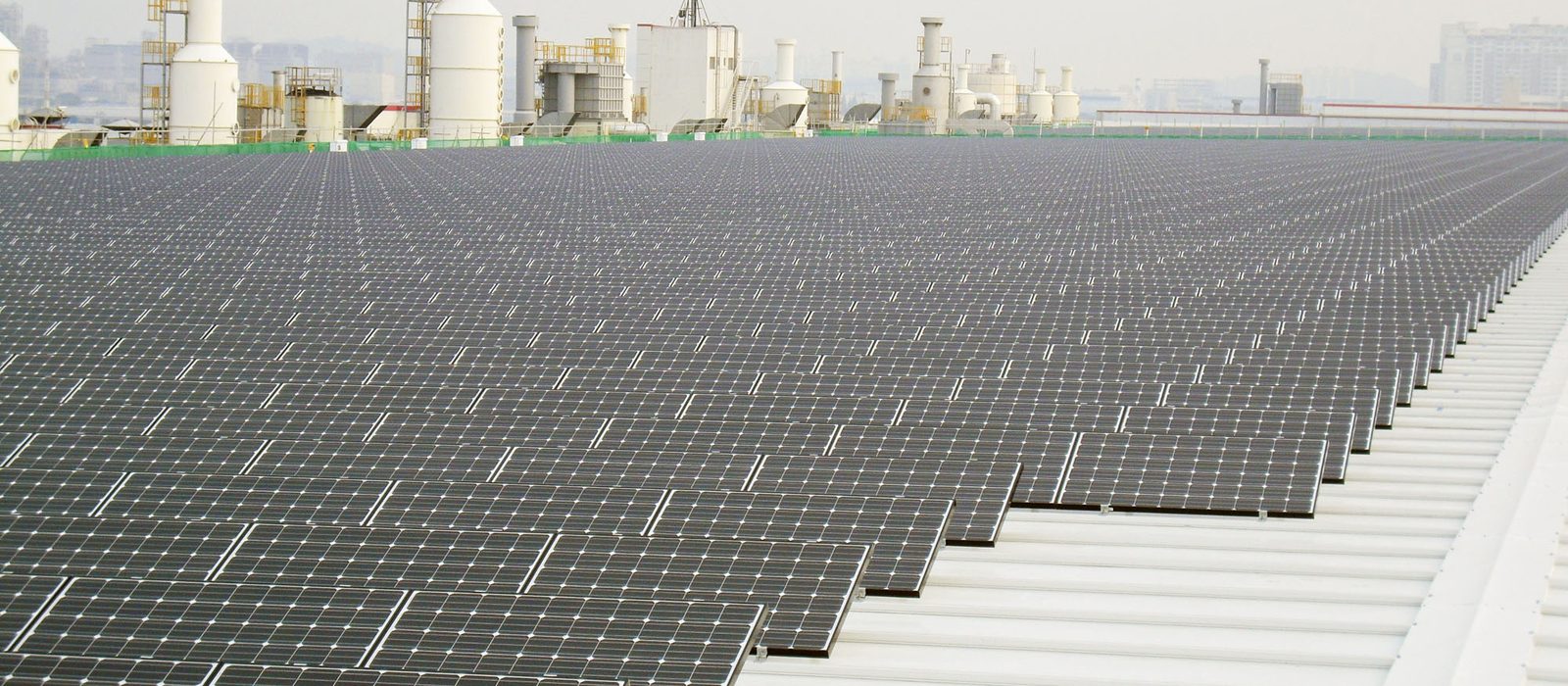
Before anyone visits your factory, you can do a rough check yourself. Take a tape measure up to the roof and use this article. Within an hour you'll know whether a 500 kW plant, or a 100 kW one, is worth talking about.
In short
- 500 kW needs about 30,000–37,500 sq ft on a metal-sheet roof, or 40,000–50,000 sq ft on a flat concrete roof, with today's 550 W-plus panels.
- Per kW: about 60–75 sq ft on metal sheet, 80–100 sq ft on flat concrete. The old rule of thumb of about 100 sq ft per kW is on the safe side.
- Count only shade-free roof. Skylights, ventilators, water tanks and walkways all come out.
- Size to your daytime load, not just your roof. A plant bigger than what your machines use during the day earns little on the extra units.
The quick answer
The figure you'll hear most often is about 100 sq ft of roof for every 1 kW of solar, which is the same as the older guideline of about 10 square metres per kW. It's a safe starting point, but it was set when panels were smaller and less powerful. With the 550 W-plus panels used on factory roofs today, most roofs need less.
How much less depends mostly on one thing: what kind of roof you have.
Illustrative default values — request a site-specific quotation. Usable shade-free area, with today's 550 W-plus panels.
Why the roof type changes the answer
Metal-sheet roofs, the kind on most factory sheds, take panels laid along the slope of the roof, clamped to the sheet or its purlins. There are no gaps between rows because one row can't shade the next. You mainly lose space to walkways for cleaning and to the edges. That's why metal sheet needs the least area: about 60–75 sq ft per kW.
Flat concrete roofs are different. Panels are tilted up on a frame, usually at a low angle of about 10° to 15° in Tamil Nadu, so they face the sun better and rain washes them. But a tilted row throws a shadow behind it, especially in the early morning and late afternoon, so each row needs a gap before the next. Those gaps are why a flat roof needs more area: about 80–100 sq ft per kW.
On a sloped shed roof, the side facing north makes slightly less power than the side facing south. At Tamil Nadu's latitude and with the low slope of most sheds, the difference is small, so both sides are usually used.
What doesn't count as usable roof
This is where most rough estimates go wrong. Walk the roof and take these out:
- Skylights and translucent sheets. Many factory sheds have a row of them for daylight. You can't put panels over them without darkening the shop floor.
- Turbo ventilators, exhaust fans and ridge vents. Panels need to stay clear of them.
- Water tanks, lift rooms and stair heads, and the shadow they cast.
- Shadow from taller buildings, chimneys and trees next door. Look at the roof at 9 am and at 4 pm, not only at noon.
- Walkways for cleaning and maintenance. Panels that can't be reached don't get cleaned, and dirty panels lose power.
On a typical factory shed, these take out somewhere between 10% and 25% of the total roof.
Check your own roof in four steps
- Measure the length and width of each roof section and multiply them.
- Subtract everything in the list above.
- Divide what's left by 65 for a metal-sheet roof, or by 90 for a flat concrete roof. That gives you a rough plant size in kW.
- Compare that with your daytime power use (next section).
Example: a shed 100 ft wide and 300 ft long is 30,000 sq ft. Take out 10% for skylights and walkways and you have 27,000 sq ft. Divided by 65, that's a plant of roughly 400 kW.
The roof is only half the question
A solar plant in Tamil Nadu makes roughly 4 units (kWh) per kW per day, averaged over the year. So a 500 kW plant makes around 2,000 units on an average day, almost all of it between about 8 am and 5 pm.
Now look at your own load. If your machines use that much power during the day, the whole plant is useful. If they don't — on Sundays, holidays or a light shift — the extra units flow to the grid, and what you get for them depends on your state's metering rules. It's usually far less than what you pay for grid power. Your electricity company's rules may also cap the plant size against your sanctioned load.
So the right plant size is the smaller of two numbers: what your roof can hold, and what your factory uses during daylight.
Is the roof strong enough, and will it last?
Panels and their mounting add weight. On a metal-sheet roof, the purlins and sheets need to be sound. Check how much life the sheets have left: a solar agreement often runs 15 to 25 years, and replacing the roof five years in means taking the plant down and putting it back up. If the sheets are near the end of their life, replace them first.
On a flat concrete roof, check the waterproofing before anything goes on top, and decide with the installer whether the frame will be anchored into the slab or held down by weight.
A proper site survey checks both. Anyone who proposes a plant without climbing onto your roof is guessing.
Not enough roof?
You still have options. Open land at your site can take a ground-mounted plant, and car parks can take a solar shed. For the load your premises can't cover, a Tamil Nadu HT connection of 63 kVA or more can buy power from a solar or wind plant elsewhere, through open access or group captive. See all three routes side by side.
Want us to check your roof?
Send us your roof dimensions, or a Google Maps pin of your factory, and one recent EB bill. We'll tell you roughly what size plant fits and whether it makes sense. If it does, Aran can build and run it with zero investment from you.
See zero-investment rooftop solar