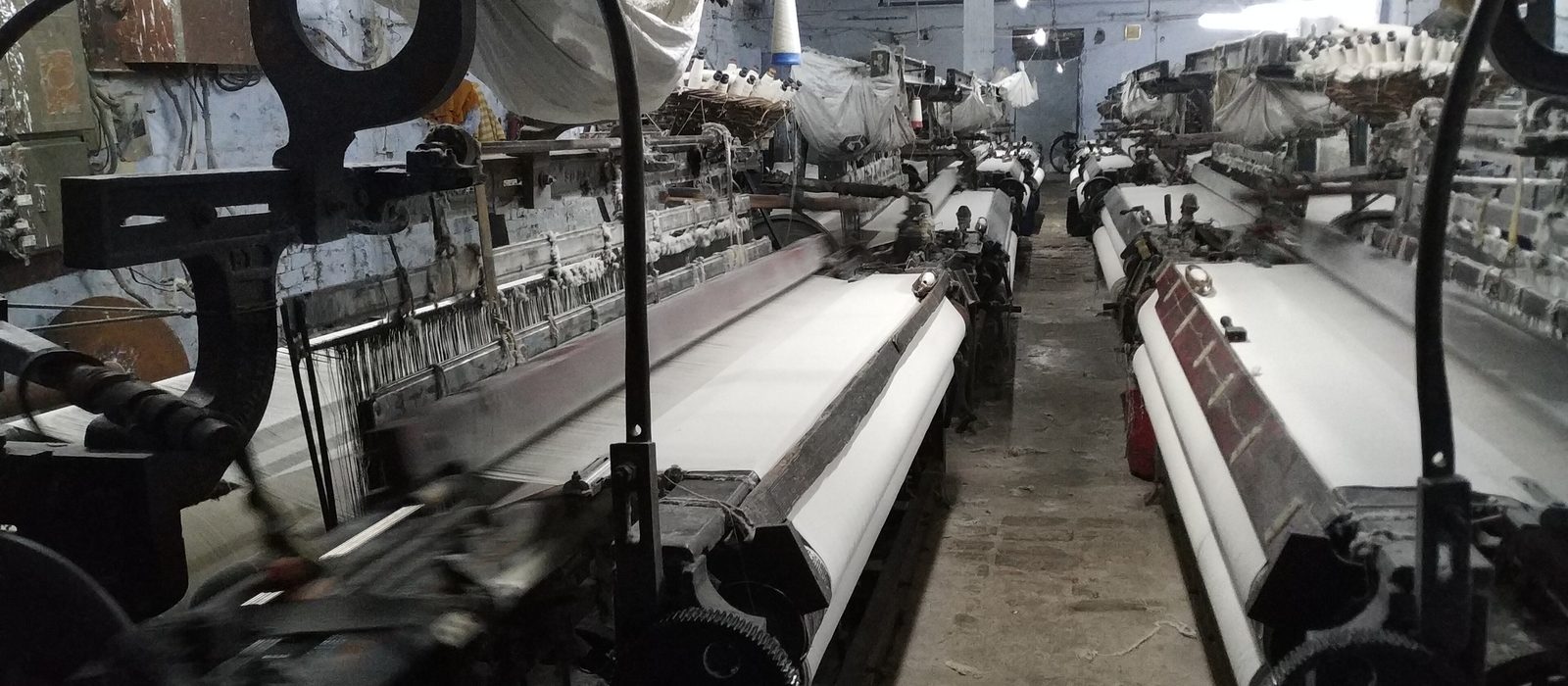
Ask a mill owner in Tiruppur, Coimbatore or Erode what hurts margins most, and the EB bill comes up right after cotton. Spinning mills run ring frames, blowroom lines and compressors almost round the clock. Weaving and processing units add looms, dyeing, drying and finishing on top. Most of that load runs in daylight, when the sun is already falling on your shed roofs.
There is no single fix. For an HT mill in Tamil Nadu there is an order that usually works: rooftop solar first, group captive solar next, and wind, bought from a wind generator, for the hours the sun cannot cover.
What you pay TNEB today
Under TNERC Tariff Order No. 6 of 2025 (in force from 1 July 2025), an HT industrial service (HT I) pays ₹7.50 per unit for energy, and an HT commercial service (HT III) pays ₹9.40. On top of that:
- Peak hours cost 25% more. Energy used from 6 to 10 am and 6 to 10 pm is charged 25% extra.
- Night hours cost 5% less. Energy used from 10 pm to 5 am gets a 5% rebate.
- The demand charge stays. ₹608 per kVA per month, on the higher of your recorded maximum demand or 90% of your contracted demand. Solar does not remove it.
Every unit your own solar supplies is a unit you do not buy at these rates.
Step 1: rooftop solar on your sheds
Textile sheds are close to ideal for rooftop solar: long, open roofs with few obstructions, and a load that runs hardest in the day, when the panels produce. Solar power used inside the mill during the day replaces TNEB units straight away.
An HT service can put up rooftop solar up to its contracted demand, with a ceiling of 999 kW and within the local transformer limit, under TNEB's rooftop schemes. The rules on export, meters and approvals are set out in our article on rooftop solar for HT factories.
You can pay for the plant yourself and own it, or take it on a zero-investment (OPEX) basis: a developer builds, owns and maintains the plant on your roof, and you pay only for the units it produces. Aran Tecnovation offers rooftop solar for factories on this zero-investment basis, so the money can stay in machinery and working capital. See zero-investment rooftop solar.
One thing to ask any installer: cleaning. Cotton lint and dust settle on panels in a mill and cut output. Ask how often the panels will be cleaned, by whom, and get it written into the maintenance contract.
Step 2: group captive solar for the rest
Most mill roofs cannot carry enough solar for a three-shift plant. Group captive solar fills the gap: a solar plant elsewhere in Tamil Nadu, part-owned by a group of buyers, sending power to your mill over the TNEB grid under open access.
What to know first:
- Who can take it. Under TNERC's Green Energy Open Access Regulations, 2025 (notified 18 September 2025), you need a contracted demand of at least 63 kVA on an HT or EHT service. LT units and small powerloom sheds cannot take open access; rooftop solar is their route.
- The ownership and use rules. The buyers together must own at least 26% of the plant company and use at least 51% of its power every year. Our group captive article explains these rules.
- Grid charges. Solar pays half the HT wheeling charge: 50% of ₹1.04, or ₹0.52 per unit (TNERC Tariff Order No. 6 of 2025). A group captive buyer who meets the 26% and 51% rules does not pay the cross-subsidy surcharge. A third-party solar buyer pays about 70% of it under earlier TNERC solar orders: about ₹1.39 per unit on HT I and ₹1.80 on HT III (full rates ₹1.99 and ₹2.57 in Tariff Order No. 6 of 2025).
- Banking. For captive and group captive solar, unused daytime units can be banked within the calendar month, at a charge of 8% in kind. Normal-hour units are used in normal hours and night units at night; units generated in peak hours can be used in any slot. Units still unused at month-end are paid at 75% of the renewable energy tariff. Third-party buyers get no banking.
The full charge list by voltage is in our Tamil Nadu open access guide.
Step 3: wind from a generator, for the night shifts
Solar covers daylight. A three-shift mill still has many hours of night load. In Tamil Nadu, wind blows strongest in the May to September season, which is why many Coimbatore and Tiruppur mills bought windmills in the past.
Aran does not build, sell or own wind turbines. For mills that want wind in the mix, we help plan the combination of rooftop solar, group captive solar and wind, and arrange the open access paperwork with the wind generator. Aran is not a power trader and never buys or sells power.
The January 2026 wind banking change
If your mill already owns an old windmill, this matters. On 14 January 2026 the Tamil Nadu government amended its 2024 policy on repowering, refurbishment and life extension of wind projects. As reported in the press:
- Banking is back to the full year. Under the 2024 policy, half of the generated energy had to be used within the May to September wind months. Now, for eligible windmills, banked units can be used any time in the same financial year (April to March), and unused units at year-end are paid at 75%.
- Which windmills. Windmills commissioned before 1 April 2016 must choose repowering, refurbishment or life extension after 20 years; newer ones can run up to 25 years. The new banking terms are for windmills that go through this process.
- Easier life extension. To qualify, a windmill used to need average generation over the last three years of at least 90%; this is now 70%, certified by the National Institute of Wind Energy or another independent agency.
- Lower charges on existing capacity. The development charge now falls mainly on the new, added capacity when you repower, with a much smaller charge on the existing capacity.
For a three-shift mill this is useful: wind units banked in the windy months can now be used in the calm months from October to April. Check with your wind operator whether your windmill qualifies and what it has to do.
When it is not worth it
- Rooftop: not if the roof is shaded, weak, or needed for vents, water tanks or a planned extension. Get a structural check first.
- Group captive: not for an LT unit, which cannot take open access. And not if your use may drop below the 51% rule, because missing it for a year brings back the surcharges for that year.
- Wind: less useful for a single-shift, daytime-only mill, which has little night load to use the units.
- Any long contract: if your load is about to change (a new shed, a new shift, new machines), size for where the load is going, not just where it is today.
The short version
Start with rooftop solar on every usable shed. Add group captive solar once the roof is full and you know the open access charges for your HT service. If you own an old windmill, check now whether the January 2026 banking change applies to it. Every mill is different: roof, shifts and existing windmills all change the answer, so ask for a site-specific study before you commit.
Illustrative default values — request a site-specific quotation.
Want to know what your mill can save?
Send us a recent HT bill and your shift pattern. We will show what rooftop solar and group captive solar can cover, with every charge listed.
See how factories cut power cost