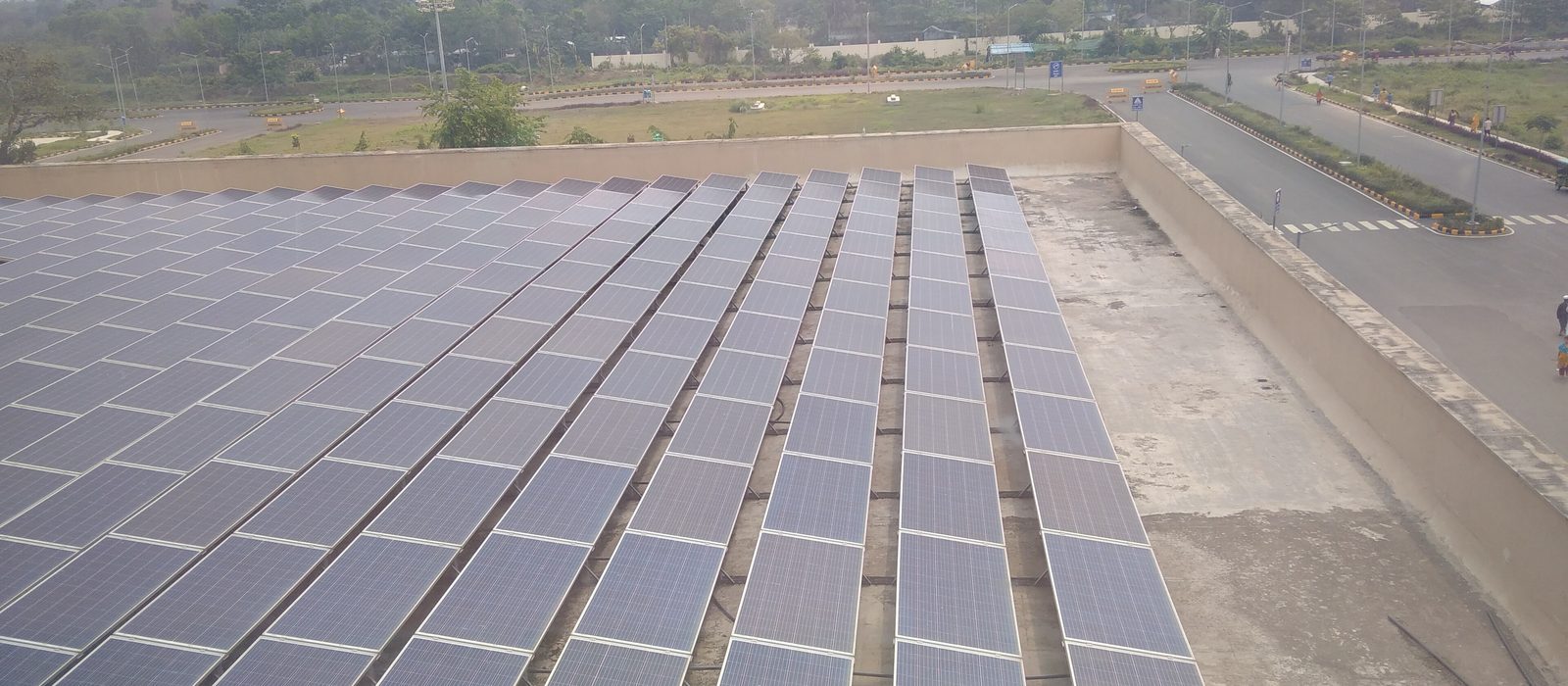
If you run a factory in Tamil Nadu on an HT connection and want solar on your own roof, the first question is not the panels. It is which scheme TNEB will put you on, because that decides what the plant does to your EB bill.
This is different from open access, where you buy solar power made somewhere else and carried to you over the grid. This article is only about a plant on your own premises, connected to your own HT service.
One note on names: everyone still says "TNEB". The company you actually deal with for your connection today is TNPDCL (Tamil Nadu Power Distribution Corporation), formed in 2024 when TANGEDCO was restructured. The rules below come from the Tamil Nadu Electricity Regulatory Commission (TNERC).
Which scheme an HT factory can use
As far as we could confirm, the rules in force are the TNERC Grid Interactive Solar PV Energy Generating Systems Regulations, 2021 and TNERC Order No. 8 of 2021 (22 October 2021). They offer three schemes, but an HT factory really has two:
- Net metering — your export is subtracted from your import, unit for unit. Under the 2021 order this is for domestic consumers, not factories.
- Net feed-in (also called net billing) — open to all consumer categories except huts and agriculture, at any voltage. Units you draw from the grid are billed at your normal tariff. Units you send out are credited at a lower feed-in rate fixed by TNERC. The plant can be as large as your sanctioned load or contracted demand, up to a maximum of 999 kW. This is the scheme most HT factories use.
- Gross metering — you sell every unit the plant makes to TNPDCL at the feed-in rate and keep buying all your power at your HT tariff. It is for plants from 151 kW to 999 kW; LT consumers cannot use it. You must lay your own service line to the nearest HT feeder to send the power out.
For a factory that runs in the daytime, net feed-in is usually the better deal. Every unit you use yourself replaces a grid unit at your full tariff, while gross metering pays you only the feed-in rate for all of it.
How big the plant can be
- Your sanctioned load or contracted demand. The plant cannot be bigger than this, whatever the size of your roof.
- 999 kW. Both net feed-in and gross metering stop at 999 kW.
- The transformer. All net metering and net feed-in plants on one distribution transformer together cannot exceed 90% of its capacity. All gross-metered plants on one power transformer cannot exceed 70% of its capacity. Space is given first come, first served, so a busy industrial area can run out.
A 2024 draft of new TNERC regulations proposes changes to some of these limits. We could not confirm it has been made final, so the figures above are from the 2021 rules. Ask the circle office which version they are applying.
The network charge: ask before you count your savings
TNERC Order No. 8 of 2021 added a network charge for rooftop plants under net metering and net feed-in, for using the grid as a backup. It was worked out on the total units the plant generates, read from a separate generation meter, so it fell on units used inside the factory too, not only on exported units. Gross metering never had a network charge, because every unit is sold to TNPDCL.
The charge has been fought over since. Its rate was revised more than once after 2021. Then, on 22 December 2024, the Madras High Court set aside network-charge demands raised on industrial rooftop solar users in a case brought by the South India Spinners Association, according to legal and press reports, and spinning mill associations have since asked TNPDCL to stop collecting it and refund it. Press reports from May 2025 say TNPDCL issued a fresh directive on the charge and the matter went back to court. We could not confirm where it stands today. The 2024 draft regulations also propose not charging it on exported units.
So we are not quoting a rate. Before you sign anything, ask TNPDCL in writing whether your plant will be billed a network charge, at what rate, and under which order, and work out your numbers both with and without it.
What happens to extra units
Under net feed-in, the money value of your exported units is subtracted from your import bill each billing cycle. If the credit is more than the bill, it carries forward to the next cycle. At the end of the year, on 31 March, you can take the balance as a payment or carry it into the next year.
This is not the same as open access banking. You are not storing units to use later; you are getting money credit at the feed-in rate, which is lower than what you pay for grid power. That is why a rooftop plant pays back best when your factory uses most of what it makes, as it makes it.
The approval steps
Since September 2023, HT rooftop applications from 1 kW to 999 kW go online to the Superintending Engineer of your Electricity Distribution Circle (EDC), not to Chennai (TANGEDCO CMD Proceedings No. 198, 14 September 2023). The steps:
- Apply online with your HT service details and plant design.
- The circle office sends a payment advice for the registration fee, within three days.
- The local Executive Engineer inspects the site and files a feasibility report, within one week.
- You get a "Noted For Record" letter, which allows you to build. The standard letter gives you 12 months to finish; if you miss it, the letter is cancelled and the transformer space goes to the next applicant.
- Build the plant, fit the generation meter, and get the safety certificate from the Electrical Inspectorate (CEIG).
- The meter testing (MRT) wing inspects, within one week of you reporting completion.
- You get the tie-up approval. The plant is connected to the grid within three days, and you sign the connection agreement.
These are office targets. Real time depends mostly on how fast your design, the inspectorate and the building work move. Plan for a buffer and ask the circle office about current waiting times.
When rooftop solar is not worth it
A plant on your own roof is not always the right answer. It is a weak fit when:
- Most of your load is at night. Solar works only in daylight. If your daytime use is small, more units go out at the lower feed-in rate.
- The demand charge is the big part of your bill. HT industrial and commercial connections pay ₹608 per kVA every month on the higher of recorded maximum demand or 90% of contracted demand (TNERC Tariff Order No. 6 of 2025). Rooftop solar cuts the energy charge (₹7.50 a unit for HT I under the same order); it does little to the demand charge.
- Your heavy load is in the peak hours. HT energy costs 25% more from 6 to 10 am and 6 to 10 pm. Solar makes little power in those hours, especially in the evening, so it does not save you much of that extra charge.
- The roof is shaded, weak or small compared with your contracted demand, or the factory may move or re-roof in the next few years.
- The transformer is already full of other solar plants.
Illustrative default values — request a site-specific quotation.
In these cases, open access or a group captive solar plant may do more for you. See our Tamil Nadu open access guide for how those charges add up.
Where zero-investment rooftop solar fits
None of the rules above change if you choose zero-investment solar instead of buying the plant. The scheme, the size limits and any network charge belong to your HT connection, whoever owns the panels. What changes is who pays for the plant and who handles the TNPDCL paperwork. With our zero-investment rooftop solar, Aran builds, owns and runs the plant on your roof and takes it through the approval steps, and you pay Aran an agreed rate under a written agreement.
Want us to check your roof and your HT bill?
Send us a recent HT bill and a photo of the roof. We will tell you which scheme fits, how big the plant can be, and what it does to your bill.
See zero-investment rooftop solar